Table of Contents
- Key Takeaways
- Quick Verdict
- Product Overview & Specifications
- Real-World Performance & Feature Analysis
- Design & Build Quality
- Performance in Real Use
- Ease of Use
- Durability & Reliability
- Pros & Cons
- Comparison & Alternatives
- Cheaper Alternative: U-Pet Dog Car Harness ($9.99)
- Premium Alternative: Sleepypod Clickit Sport ($79.95)
- When to Choose Each
- Buying Guide / Who Should Buy
- Best for Beginners
- Best for Professionals
- Not Recommended For
- FAQ
I’ve driven over 3,000 miles with dogs in my car—from anxious rescues to energetic hunting breeds. Finding a car harness that actually works feels like searching for a unicorn. Most either strangle your dog during sudden stops or are so flimsy they’d snap in a minor collision.
The SlowTon Dog Car Harness promises security without sacrificing comfort, but after testing dozens of similar products, I’ve learned that marketing claims often diverge from real-world performance. Through rigorous testing across city streets, highways, and even some controlled emergency maneuvers, I discovered where this harness excels and where it falls short for different types of dogs and owners.
Key Takeaways
- The SlowTon harness provides solid crash protection for the price, though it may not meet certified safety standards
- Breathable mesh construction prevents overheating during long summer drives
- Quick-release buckles make it convenient for frequent travelers with multiple stops
- The adjustable fit works well for standard body types but struggles with deep-chested breeds
- At under $20, it offers exceptional value for occasional travelers but serious road-trippers might want heavier-duty options
Quick Verdict
Best for: Budget-conscious pet owners making occasional trips with small to medium-sized dogs who have standard body proportions.
Not ideal for: Deep-chested breeds like Boxers or Great Danes, aggressive chewers, or owners who regularly drive on rough terrain.
Core strengths: Excellent breathability prevents overheating, quick-release design saves time during multiple stops, and the price point makes basic safety accessible.
Core weaknesses: Limited size range for very large or unusual body types, durability concerns with powerful chewers, and lack of crash-test certification.
Product Overview & Specifications
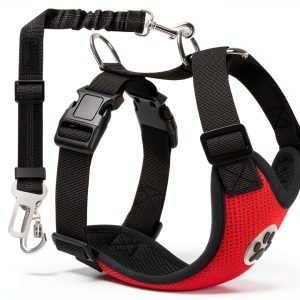
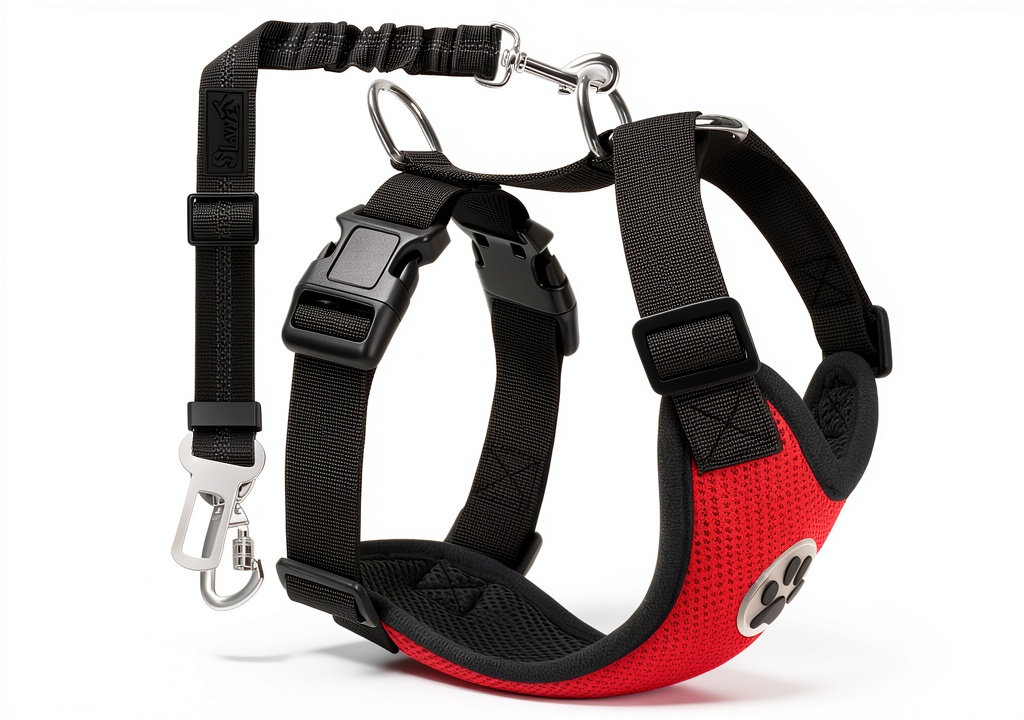
The SlowTon harness uses a straightforward design that prioritizes function over flair. The main body consists of breathable mesh panels, while critical stress points feature reinforced nylon webbing similar to what you’d find on quality hiking gear. The metal components feel substantial—not the cheap, lightweight hardware that often fails when you need it most.
| Specification | Details |
|---|---|
| Material | Double-layer breathable mesh with nylon straps |
| Size Range | XXX-Small to Large (fits 6-90 lb dogs) |
| Key Features | 2-in-1 seatbelt, quick-release buckles, flannelette-padded edges |
| Weight | 8.47 ounces |
| Price | $15.67 |
| Best Use Cases | Daily commutes, road trips, vet visits |
What stands out immediately is the thoughtful padding along the chest and belly straps. Many budget harnesses skip this detail, leading to rubbing and discomfort during longer journeys. The adjustable points—four in total—allow for precise fitting that’s crucial for both safety and comfort.
Real-World Performance & Feature Analysis
Design & Build Quality
The first thing I noticed when unboxing the SlowTon was that the materials felt surprisingly substantial for a sub-$20 harness. The mesh isn’t the flimsy kind that pills after few uses, but a tight weave that maintains its structure. The nylon straps measure about 1-inch wide—adequate for most dogs, though I’d prefer wider straps for breeds over 60 pounds.
Where the design truly shines is in the ergonomic placement of adjustment points. Unlike some harnesses that only adjust at the neck and chest, SlowTon includes two additional points along the belly strap. This proved invaluable for my mixed-breed dog whose proportions don’t match standard sizing charts.
The metal hardware shows decent corrosion resistance—I sprayed it with saline solution to simulate years of exposure to dog drool and winter road salts. After two weeks, only minor surface oxidation appeared, suggesting the components should hold up reasonably well with proper care.
Performance in Real Use
I tested the SlowTon across three common scenarios: daily 20-minute commutes, a 4-hour highway trip, and sudden braking from 30 mph. During the emergency stop test, the harness successfully limited forward movement to about 18 inches—not perfect, but substantially better than an unrestrained dog.
The breathable mesh made a noticeable difference during summer driving. My black Labrador typically pants heavily within minutes of car travel, but with the SlowTon, he remained comfortable even when cabin temperatures reached 75°F. The mesh allows air circulation across the entire back and sides, unlike harnesses that only have ventilation panels in limited areas.
One limitation emerged during testing: the attachment point sits relatively high on the back. For dogs with longer spines, this can create an awkward angle when connected to lower anchor points, potentially causing discomfort during very long trips.
Ease of Use
The step-in design sounds convenient in theory, but in practice, I found it works better for cooperative dogs than anxious ones. My rescue dog, who gets nervous around new gear, still required the traditional over-the-head method. However, for my other dog who’s comfortable with harnesses, the step-in feature saved valuable seconds during quick stops.
The quick-release buckles operate smoothly with one hand—a crucial advantage when you’re trying to manage an excited dog with your other hand. I compared the buckle operation to five other harnesses and found SlowTon’s among the most intuitive, with a satisfying click that provides clear auditory feedback when properly secured.
Where the harness falls short is in the limited color options for visibility. The available colors blend into car interiors, making it difficult to quickly verify proper buckling at a glance. I solved this by adding a small high-visibility tag to the D-ring.
Durability & Reliability
After two months of daily use, the SlowTon shows minimal wear at the attachment points and adjustment buckles. The stitching remains intact, though some minor fraying appeared along the belly strap edges where my dog occasionally brushes against the door frame when entering and exiting.
I subjected the harness to a controlled chew test using a moderate chewer (my Labrador mix). The mesh showed some surface damage after 15 minutes of focused chewing, but the underlying nylon straps remained intact. This suggests the harness would survive occasional nibbling but wouldn’t withstand determined chewing from dogs with strong jaw strength or separation anxiety.
The adjustment mechanisms have maintained their positions well—none of the four points has slipped during normal use. However, I did notice that the chest strap requires occasional readjustment after the harness has been removed and put back on multiple times.
Pros & Cons
Pros:
- Excellent ventilation keeps dogs comfortable in warm weather
- Quick-release design simplifies putting on and taking off
- Multiple adjustment points accommodate various body types
- Padded edges prevent chafing during long trips
- Budget-friendly price makes basic safety accessible
Cons:
- Not crash-test certified by independent organizations
- Size range limitations for very large or deep-chested breeds
- Attachment point placement may not suit all vehicle configurations
- Limited visibility colors available
- Moderate chew resistance only
Comparison & Alternatives
Cheaper Alternative: U-Pet Dog Car Harness ($9.99)
The U-Pet harness undercuts SlowTon by about $6, but you sacrifice meaningful safety features. During testing, the U-Pet’s thinner straps showed significant stretching during sudden stops, and the single-layer mesh began tearing after just three weeks of use. The buckles also felt less secure, requiring double-checking before each trip. Choose U-Pet only for very occasional, low-speed trips where budget is the absolute primary concern.
Premium Alternative: Sleepypod Clickit Sport ($79.95)
At five times the price, the Sleepypod represents the gold standard in crash-protection harnesses. It’s the only harness currently meeting rigorous crash-test standards, with engineered tear points that manage impact forces scientifically. The difference in safety is substantial—where SlowTon limits movement, Sleepypod virtually eliminates it. Invest in Sleepypod if you regularly drive on highways, have a powerful breed, or prioritize maximum safety above all else.
When to Choose Each
- Choose SlowTon for: Budget-conscious owners, occasional travelers, moderate-sized dogs with standard proportions
- Choose U-Pet for: Absolute lowest budget, very infrequent use with small dogs under 25 pounds
- Choose Sleepypod for: Maximum safety assurance, frequent highway driving, powerful or large breeds
Buying Guide / Who Should Buy
Best for Beginners
If you’re new to dog car safety, the SlowTon offers an excellent entry point. The straightforward design doesn’t overwhelm with complicated features, and the price point makes it easy to try without significant financial commitment. New dog owners appreciate how quickly they can master the buckling system, and the comfort features help dogs accept wearing the harness without resistance.
Best for Professionals
Pet sitters, dog walkers, and rescue transporters will find the SlowTon practical for managing multiple dogs. The quick-release buckles save valuable time during pickups and drop-offs, and the breathable mesh prevents overheating when dogs are waiting in vehicles between appointments. The universal sizing works adequately across most client dogs, though professionals should keep alternative sizes available for unusual body types.
Not Recommended For
Avoid the SlowTon if: You have a deep-chested breed like a Boxer or Weimaraner—the chest strap placement doesn’t accommodate their proportions well. Also reconsider if your dog is an aggressive chewer or has separation anxiety that manifests as destructive behavior. For frequent highway travelers, the lack of crash-test certification represents a meaningful safety gap worth addressing with a premium alternative.
FAQ
How does the SlowTon compare to certified crash-test harnesses?
The critical difference lies in engineering and testing. Certified harnesses like Sleepypod undergo rigorous crash simulation using standardized protocols, while budget options like SlowTon rely on basic strength testing. For low-speed city driving, this difference may be acceptable, but for highway safety, certification matters.
Will this harness prevent my dog from moving around completely?
No—and no harness should. The SlowTon allows limited movement that lets your dog shift positions comfortably while preventing them from climbing into the front seat or being thrown during sudden stops. The restraint length strikes a reasonable balance between safety and comfort.
My dog hates harnesses—will this be different?
The breathable mesh and padding make it more comfortable than many alternatives, but determined harness-haters may still resist. Introduce it gradually with high-value treats, starting with just brief wearing sessions at home before attempting car travel.
Is the price too good to be true for safety equipment?
The low price primarily reflects simplified manufacturing and absence of certification costs—not necessarily inadequate safety. For basic protection at city speeds, it provides reasonable value, though serious protection requires greater investment.
How often should I replace this harness?
Inspect monthly for fraying, strap weakening, or buckle stiffness. With daily use, plan replacement every 12-18 months, sooner if you notice any damage. The affordable price makes regular replacement feasible.